The Quail Story: Desert Survivors Built on Community
![]()

I'm sitting on my brother's porch in the California desert, coffee in hand, watching a family of quail parade across the sandy soil like they own the place. They're pecking, scratching, chuckling to each other in that low, conversational way that sounds almost like gossiping.
One bird stands watch on a low rock, perfectly still, head turning side to side, while the rest of the covey feeds below. Every few minutes they rotate. Another bird hops up to take sentinel duty, and the lookout rejoins the group to forage.
It's 9 AM and already pushing 90 degrees. By afternoon, this place will be an oven. And yet here these plump little birds are, thriving in conditions that would wreck most species.
Get the Quail Tattoo
Built for the Harsh Stuff
California quail, with their jaunty comma-shaped topknots and intricate scaled bellies, don't look like desert survivors. They look like they should be living somewhere with running water. Lush gardens. Maybe a nice chaparral hillside with morning fog.

But these birds pull off something remarkable: they can extract up to 90% of their water needs from the food they eat. Seeds, leaves, cactus fruit, insects. All of it gets processed through specialized kidneys that wring out every possible drop of moisture and concentrate their waste to near-nothing.
When water is available, sure, they'll drink. But in a pinch? They can go days, even weeks, getting everything they need from the dry seeds and succulent plants they forage. It's an evolutionary flex that puts them in the same league as kangaroo rats and other desert specialists.
Their daily schedule reflects this. They are active in early morning and late afternoon when temperatures are bearable, and hunker down in the shade during the brutal midday heat.
Add to Cart While In Season
Strength in Numbers
What really strikes me about quail, though, is how deeply social they are.
Outside of breeding season, quail form groups called coveys. Sometimes 10 to 20 birds, sometimes as many as 75. These aren't just loose associations. They're tight-knit family units with complex social hierarchies, cooperative behaviors, and constant communication.
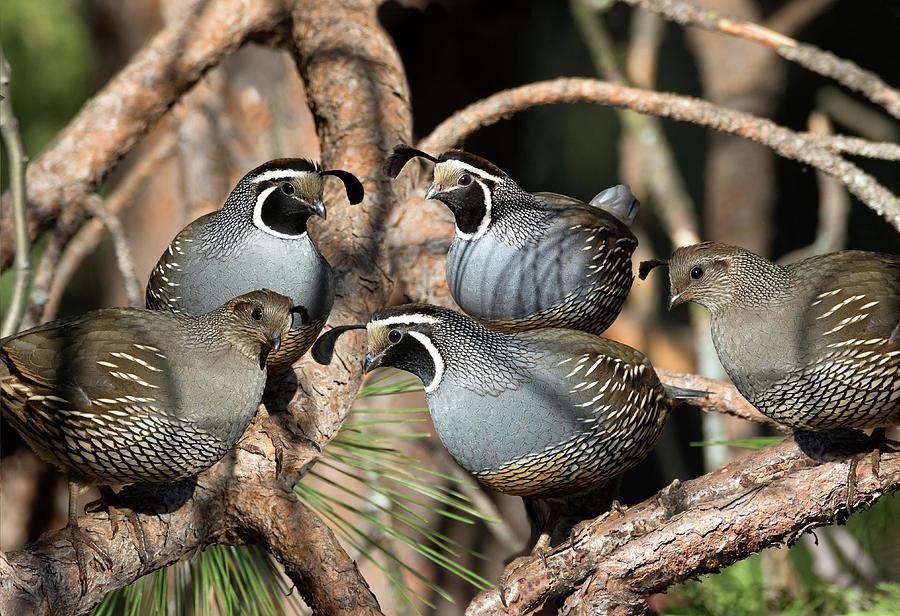
That low chuckling I keep hearing? That's the covey staying in contact while they forage. Quoit, oit, woet. Little grunts and clucks that say "I'm here, you're there, we're all good."
If a bird gets separated, it'll give a louder assembly call, chi-CA-go-go, and the group responds. They use their voices to coordinate movement, warn of danger, locate mates, and keep the family together. It's a running conversation that never really stops.
And that sentinel behavior? That's not random. When the covey is feeding or dust-bathing, one bird volunteers to stand guard in full exposure to predators. Hawks, coyotes, snakes. All legitimate threats. But the lookout stays vigilant so the rest of the group can eat safely. Then they swap. It's a system built on trust and cooperation, refined over thousands of generations.
Celebrate Cooperation and Order Now
Runners, Not Flyers
Quail are ground birds through and through. They'd much rather run than fly, and honestly, they're built for it. Short wings, plump bodies, strong legs. When startled, they explode into flight with a burst of wingbeats that sounds like someone shaking out a bedsheet, but they don't go far. Just far enough to escape immediate danger, then back to the ground.
In the sparse, open desert landscape, this would normally be a problem. There's not a lot of cover to hide in. But quail have figured out that being conspicuous isn't necessarily a death sentence if you've got numbers and vigilance on your side.
Gambel's quail, close relatives of California quail, common in Arizona and the Sonoran Desert, take this even further. They parade around in broad daylight, calling loudly, moving in groups. In dense forest, that would be a death wish. In the desert, where hiding is nearly impossible anyway, it's almost like they've decided: why waste energy being secretive when we could just watch each other's backs instead?
Get Your Quail Temp Tat
Boom and Bust
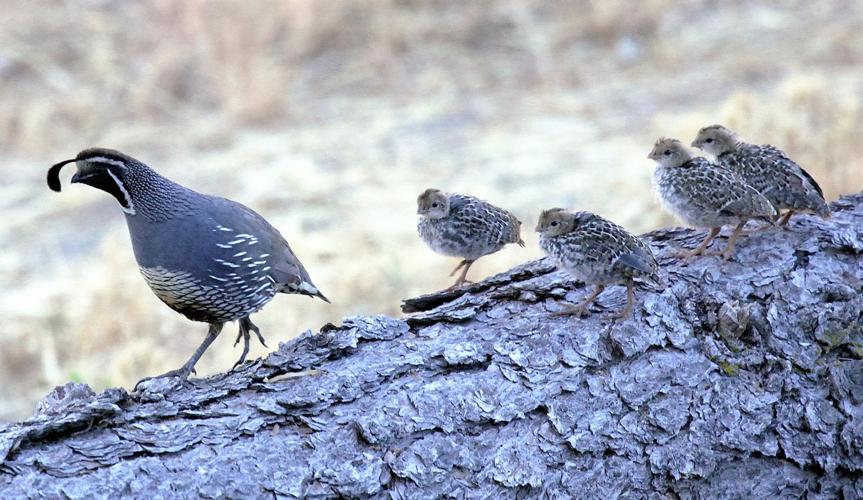
Desert quail populations follow a "boom and bust" cycle tied directly to rainfall. A wet winter means abundant green vegetation in spring, which translates to larger clutches of eggs and higher chick survival. Females might lay 13 to 16 eggs, sometimes more, and if conditions are right, most of those chicks make it.
A dry winter? The opposite. Fewer eggs, lower productivity, tougher survival odds.
It's a strategy that makes sense in unpredictable environments. Go big when resources are plentiful, hunker down when they're not. The birds don't fight the desert's rhythms. They roll with them.
Before the chicks even hatch, there's something beautiful that happens. If the eggs are touching each other, the pre-hatched chicks can communicate from inside their shells. They coordinate their hatching so they all break out at roughly the same time. The whole brood emerges together, ready to follow their parents into a world that doesn't offer second chances.
Make Your Choice - Buy the Quail Tattoo
A Quick Note on History
Quail have been hunted by humans for millennia. Native Californians prized their feathers for basketry and clothing, and their meat has always been valued as game. But unlike many species that struggled under hunting pressure, quail populations have generally held steady. California quail, in particular, have adapted well to living near humans. Parks, golf courses, suburban yards. Anywhere with a bit of brush cover and open ground works for them.
They're the state bird of California (and have been since 1931), which feels fitting. Resilient, adaptable, community-oriented, thriving in landscapes that look inhospitable at first glance.
Why This Design Matters to Us
![]()

When we were developing this quail temporary tattoo, we kept coming back to the idea of community as survival.
Quail don't make it alone. They survive through cooperation, through sentinel duty and shared vigilance, through communication and coordination, through showing up for each other even when conditions are harsh.
That felt like something worth celebrating. These aren't flashy birds. They don't migrate thousands of miles or sing elaborate songs. They're just plump, grounded, unglamorous survivors who've figured out that the best way to make it through extreme conditions is together.
So here's to the birds that refuse to do it alone. The ones that chuckle to each other in the shade, rotate lookout duty without being asked, and hatch their babies in sync. The ones that teach us that resilience isn't just about individual strength. It's about building systems where everyone looks out for everyone else.
Want to support quail in your area? Plant native shrubs for cover, leave patches of bare ground for dust-bathing, and provide low water sources during dry months. If you're in quail territory, you might just wake up to that familiar chi-CA-go call echoing across your yard.
Add Quail to Your Collection


The Quail Story: Desert Survivors Built on Community
I'm sitting on my brother's porch in the California desert, coffee in hand, watching a family of quail parade across the sandy soil like they own the place. They're pecking, scratching, chuckling to each other in that low, conversational way that sounds almost like gossiping.
One bird stands watch on a low rock, perfectly still, head turning side to side, while the rest of the covey feeds below. Every few minutes they rotate. Another bird hops up to take sentinel duty, and the lookout rejoins the group to forage.
It's 9 AM and already pushing 90 degrees. By afternoon, this place will be an oven. And yet here these plump little birds are, thriving in conditions that would wreck most species.
Get the Quail Tattoo
Built for the Harsh Stuff
California quail, with their jaunty comma-shaped topknots and intricate scaled bellies, don't look like desert survivors. They look like they should be living somewhere with running water. Lush gardens. Maybe a nice chaparral hillside with morning fog.
But these birds pull off something remarkable: they can extract up to 90% of their water needs from the food they eat. Seeds, leaves, cactus fruit, insects. All of it gets processed through specialized kidneys that wring out every possible drop of moisture and concentrate their waste to near-nothing.
When water is available, sure, they'll drink. But in a pinch? They can go days, even weeks, getting everything they need from the dry seeds and succulent plants they forage. It's an evolutionary flex that puts them in the same league as kangaroo rats and other desert specialists.
Their daily schedule reflects this. They are active in early morning and late afternoon when temperatures are bearable, and hunker down in the shade during the brutal midday heat.
Add to Cart While In Season
Strength in Numbers
What really strikes me about quail, though, is how deeply social they are.
Outside of breeding season, quail form groups called coveys. Sometimes 10 to 20 birds, sometimes as many as 75. These aren't just loose associations. They're tight-knit family units with complex social hierarchies, cooperative behaviors, and constant communication.
That low chuckling I keep hearing? That's the covey staying in contact while they forage. Quoit, oit, woet. Little grunts and clucks that say "I'm here, you're there, we're all good."
If a bird gets separated, it'll give a louder assembly call, chi-CA-go-go, and the group responds. They use their voices to coordinate movement, warn of danger, locate mates, and keep the family together. It's a running conversation that never really stops.
And that sentinel behavior? That's not random. When the covey is feeding or dust-bathing, one bird volunteers to stand guard in full exposure to predators. Hawks, coyotes, snakes. All legitimate threats. But the lookout stays vigilant so the rest of the group can eat safely. Then they swap. It's a system built on trust and cooperation, refined over thousands of generations.
Celebrate Cooperation and Order Now
Runners, Not Flyers
Quail are ground birds through and through. They'd much rather run than fly, and honestly, they're built for it. Short wings, plump bodies, strong legs. When startled, they explode into flight with a burst of wingbeats that sounds like someone shaking out a bedsheet, but they don't go far. Just far enough to escape immediate danger, then back to the ground.
In the sparse, open desert landscape, this would normally be a problem. There's not a lot of cover to hide in. But quail have figured out that being conspicuous isn't necessarily a death sentence if you've got numbers and vigilance on your side.
Gambel's quail, close relatives of California quail, common in Arizona and the Sonoran Desert, take this even further. They parade around in broad daylight, calling loudly, moving in groups. In dense forest, that would be a death wish. In the desert, where hiding is nearly impossible anyway, it's almost like they've decided: why waste energy being secretive when we could just watch each other's backs instead?
Get Your Quail Temp Tat
Boom and Bust
Desert quail populations follow a "boom and bust" cycle tied directly to rainfall. A wet winter means abundant green vegetation in spring, which translates to larger clutches of eggs and higher chick survival. Females might lay 13 to 16 eggs, sometimes more, and if conditions are right, most of those chicks make it.
A dry winter? The opposite. Fewer eggs, lower productivity, tougher survival odds.
It's a strategy that makes sense in unpredictable environments. Go big when resources are plentiful, hunker down when they're not. The birds don't fight the desert's rhythms. They roll with them.
Before the chicks even hatch, there's something beautiful that happens. If the eggs are touching each other, the pre-hatched chicks can communicate from inside their shells. They coordinate their hatching so they all break out at roughly the same time. The whole brood emerges together, ready to follow their parents into a world that doesn't offer second chances.
Make Your Choice - Buy the Quail Tattoo
A Quick Note on History
Quail have been hunted by humans for millennia. Native Californians prized their feathers for basketry and clothing, and their meat has always been valued as game. But unlike many species that struggled under hunting pressure, quail populations have generally held steady. California quail, in particular, have adapted well to living near humans. Parks, golf courses, suburban yards. Anywhere with a bit of brush cover and open ground works for them.
They're the state bird of California (and have been since 1931), which feels fitting. Resilient, adaptable, community-oriented, thriving in landscapes that look inhospitable at first glance.
Why This Design Matters to Us
When we were developing this quail temporary tattoo, we kept coming back to the idea of community as survival.
Quail don't make it alone. They survive through cooperation, through sentinel duty and shared vigilance, through communication and coordination, through showing up for each other even when conditions are harsh.
That felt like something worth celebrating. These aren't flashy birds. They don't migrate thousands of miles or sing elaborate songs. They're just plump, grounded, unglamorous survivors who've figured out that the best way to make it through extreme conditions is together.
So here's to the birds that refuse to do it alone. The ones that chuckle to each other in the shade, rotate lookout duty without being asked, and hatch their babies in sync. The ones that teach us that resilience isn't just about individual strength. It's about building systems where everyone looks out for everyone else.
Want to support quail in your area? Plant native shrubs for cover, leave patches of bare ground for dust-bathing, and provide low water sources during dry months. If you're in quail territory, you might just wake up to that familiar chi-CA-go call echoing across your yard.
Add Quail to Your Collection