The Jackrabbit Story: Born Running
I almost missed it.
We were hiking a trail out in Big Bend, moving slow in the late afternoon heat, watching the light go flat and copper over the Chisos. The shrub was dense and still. Nothing moved. Not even the air. And then, without any warning, no rustle, no buildup, something exploded out of the brush about ten feet in front of us.
It took a second to process what I was seeing. A jackrabbit, full stride, bounding across the open scrub in leaps so long they looked almost slow-motion! Ten feet at a time. The tips of those enormous ears bobbing in and out of the sagebrush, the only visible features, as it put distance between us without seeming to try. Gone in seconds, the desert went still again like nothing had happened.
That's the thing about jackrabbits. You don't find them, they find you. By that point they're already gone.
Get the Jackrabbit Tattoo
Built for Open Country

The black-tailed jackrabbit isn't actually a rabbit. It's a hare, which matters more than it sounds. Rabbits are born helpless, blind, hairless, completely dependent. Hares are born ready, fully furred, eyes open, capable of running within hours of birth. Where a rabbit needs weeks of protection to survive, a jackrabbit enters their world already adapted to it.
They've been ready since day one.
Their hind legs are long and powerful, designed for rapid acceleration and evading predators. They can hit speeds up to 40 mph and cover more than ten feet in a single leap. They don't run in straight lines, they zig-zag, cut, double back, using unpredictable movement to break a predator's stride.
Their eyes are set wide on their heads, giving them nearly 360-degree vision. While you're watching them, they're watching everything else. Raptors. Coyotes. Bobcats. Foxes. Snakes. You and your friends. And their nose? Their sense of smell is roughly twenty times stronger than a human's. By the time you notice a jackrabbit, it has already been aware of you for a while.
Their Ears Have a Job
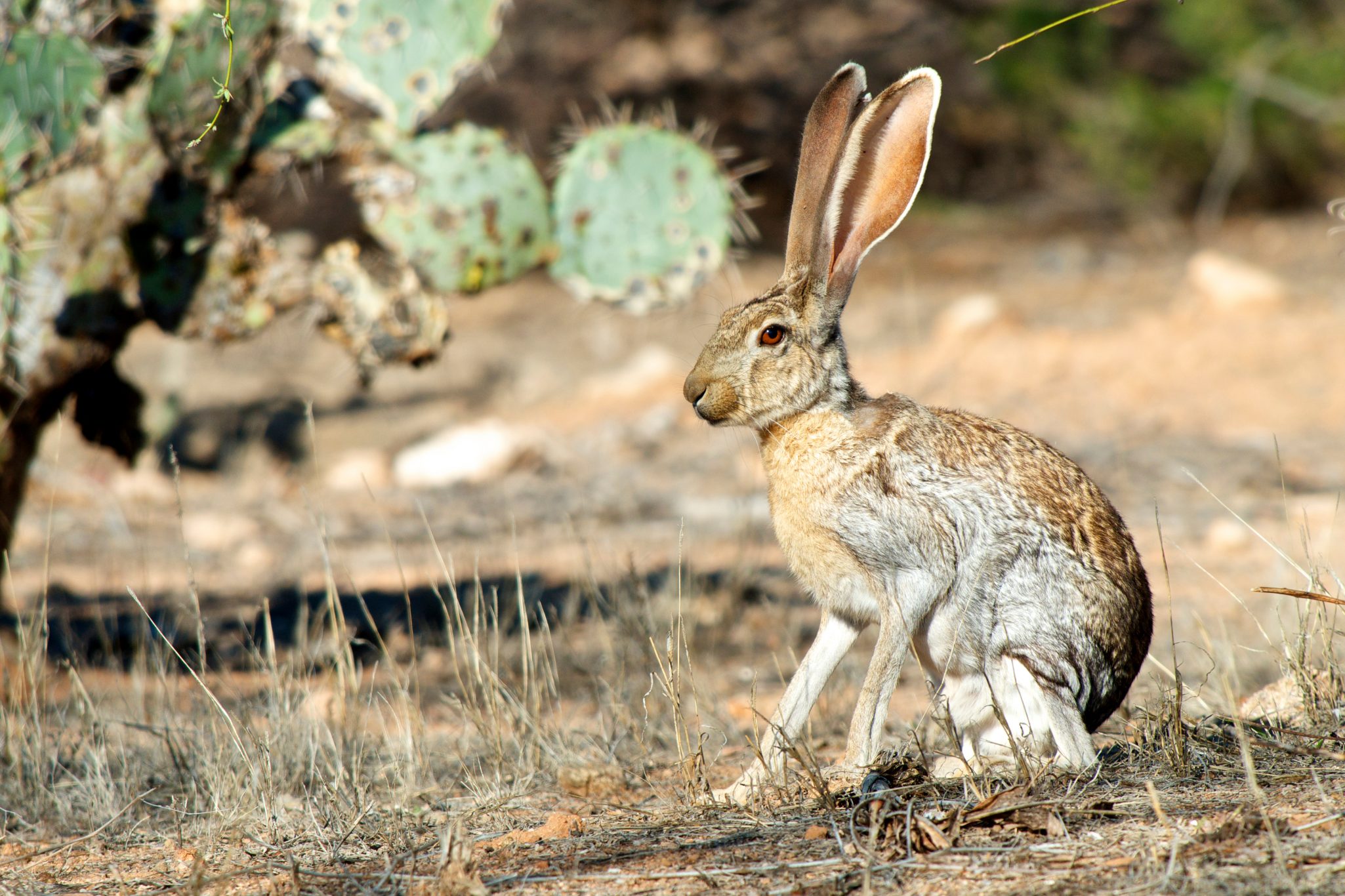
Those ears aren't just for listening, though they do that well. A jackrabbit's ears can reach around seven inches long, nearly the length of an average human forearm. They're laced with blood vessels, and on hot days, the jackrabbit pumps blood into them, radiating heat out through their thin, paper-like skin. It's a built-in cooling system, a radiator, running constantly in the desert heat.

This matters because jackrabbits don't burrow. They don't dig dens or retreat underground when temperatures climb. They live entirely in open country, in Texas prairies, desert scrublands, and grasslands, exposed to whatever the day brings. No shade unless they find it. No shelter unless they make one.
They do most of their feeding at night, grazing on grasses, shrubs, and even cacti, getting all the moisture they can through the stored water in these plants. They can survive on tough, dry vegetation, the kind of food most animals wouldn't even bother with.
That's the difference between an animal adapted to a place and one that merely tolerates it. The jackrabbit doesn't endure the heat, it thrives in it.
What They Mean to a Place
A jackrabbit population tells you something about where it lives.
Their numbers rise and fall with rainfall and food availability. When a landscape is healthy, connected, open, with enough native plant cover to support both grazers and predators, jackrabbits thrive, and so does everything that depends on them. When things fall out of balance, the jackrabbits are often the first indicator. When the jackrabbits disappear, it's rarely just about the jackrabbits.
Their grazing influences which plants dominate in grasslands and desert scrub. The predators that rely on them, like raptors, coyotes, bobcats, foxes, and snakes, shape their behavior, which in turn shapes how they move through and use a landscape. It's all connected, and the jackrabbit is somewhere near the center of it.
Why This Design

When we were developing the jackrabbit tattoo, we kept coming back to that moment in Big Bend. The stillness. Then the burst of energy. The bobbing ears disappearing into the scrub.
There's something in that image about readiness. About being so adapted to your environment that you can hold perfectly still, invisible, until the exact moment you need to move, and then move faster than anything or anyone expects.
Jackrabbits don't warm-up. They don't ease into spring, or into the day, or into a threat. They're already ready and running.
That felt like something worth carrying.
Add Jackrabbit to Your Collection


The Jackrabbit Story: Born Running
I almost missed it.
We were hiking a trail out in Big Bend, moving slow in the late afternoon heat, watching the light go flat and copper over the Chisos. The shrub was dense and still. Nothing moved. Not even the air. And then, without any warning, no rustle, no buildup, something exploded out of the brush about ten feet in front of us.
It took a second to process what I was seeing. A jackrabbit, full stride, bounding across the open scrub in leaps so long they looked almost slow-motion! Ten feet at a time. The tips of those enormous ears bobbing in and out of the sagebrush, the only visible features, as it put distance between us without seeming to try. Gone in seconds, the desert went still again like nothing had happened.
That's the thing about jackrabbits. You don't find them, they find you. By that point they're already gone.
Get the Jackrabbit Tattoo
Built for Open Country
The black-tailed jackrabbit isn't actually a rabbit. It's a hare, which matters more than it sounds. Rabbits are born helpless, blind, hairless, completely dependent. Hares are born ready, fully furred, eyes open, capable of running within hours of birth. Where a rabbit needs weeks of protection to survive, a jackrabbit enters their world already adapted to it.
They've been ready since day one.
Their hind legs are long and powerful, designed for rapid acceleration and evading predators. They can hit speeds up to 40 mph and cover more than ten feet in a single leap. They don't run in straight lines, they zig-zag, cut, double back, using unpredictable movement to break a predator's stride.
Their eyes are set wide on their heads, giving them nearly 360-degree vision. While you're watching them, they're watching everything else. Raptors. Coyotes. Bobcats. Foxes. Snakes. You and your friends. And their nose? Their sense of smell is roughly twenty times stronger than a human's. By the time you notice a jackrabbit, it has already been aware of you for a while.
Their Ears Have a Job
Those ears aren't just for listening, though they do that well. A jackrabbit's ears can reach around seven inches long, nearly the length of an average human forearm. They're laced with blood vessels, and on hot days, the jackrabbit pumps blood into them, radiating heat out through their thin, paper-like skin. It's a built-in cooling system, a radiator, running constantly in the desert heat.
This matters because jackrabbits don't burrow. They don't dig dens or retreat underground when temperatures climb. They live entirely in open country, in Texas prairies, desert scrublands, and grasslands, exposed to whatever the day brings. No shade unless they find it. No shelter unless they make one.
They do most of their feeding at night, grazing on grasses, shrubs, and even cacti, getting all the moisture they can through the stored water in these plants. They can survive on tough, dry vegetation, the kind of food most animals wouldn't even bother with.
That's the difference between an animal adapted to a place and one that merely tolerates it. The jackrabbit doesn't endure the heat, it thrives in it.
What They Mean to a Place
A jackrabbit population tells you something about where it lives.
Their numbers rise and fall with rainfall and food availability. When a landscape is healthy, connected, open, with enough native plant cover to support both grazers and predators, jackrabbits thrive, and so does everything that depends on them. When things fall out of balance, the jackrabbits are often the first indicator. When the jackrabbits disappear, it's rarely just about the jackrabbits.
Their grazing influences which plants dominate in grasslands and desert scrub. The predators that rely on them, like raptors, coyotes, bobcats, foxes, and snakes, shape their behavior, which in turn shapes how they move through and use a landscape. It's all connected, and the jackrabbit is somewhere near the center of it.
Why This Design
When we were developing the jackrabbit tattoo, we kept coming back to that moment in Big Bend. The stillness. Then the burst of energy. The bobbing ears disappearing into the scrub.
There's something in that image about readiness. About being so adapted to your environment that you can hold perfectly still, invisible, until the exact moment you need to move, and then move faster than anything or anyone expects.
Jackrabbits don't warm-up. They don't ease into spring, or into the day, or into a threat. They're already ready and running.
That felt like something worth carrying.
Add Jackrabbit to Your Collection